




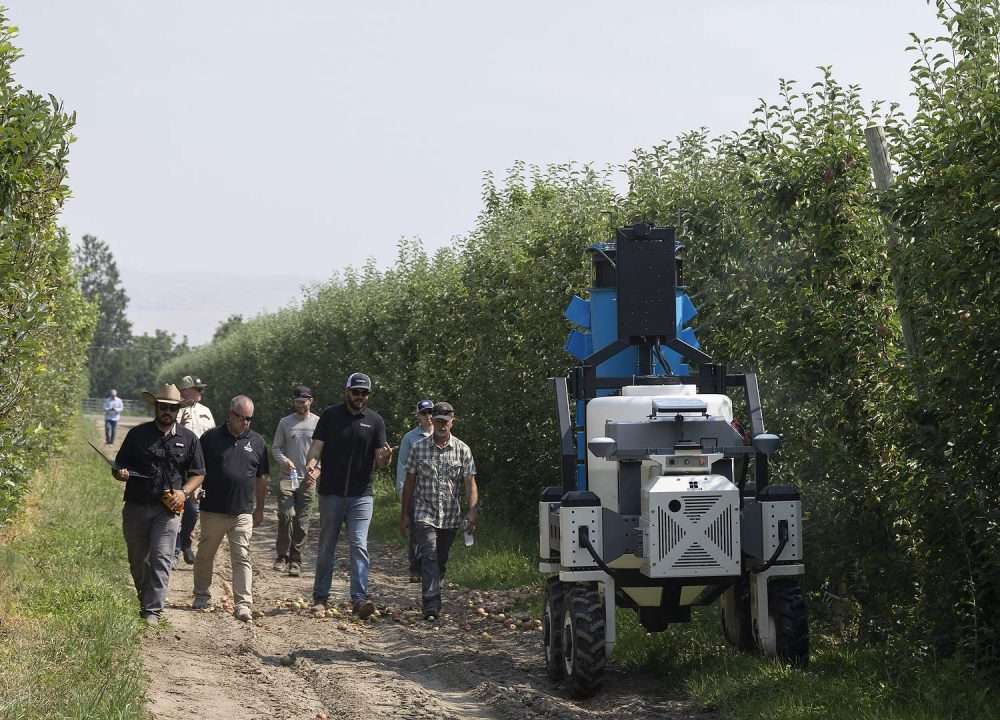
A Bay Area ag tech startup held grower demonstrations of its autonomous platforms on July 22 in Washington’s Yakima Valley as the company courts the Northwest tree fruit market.
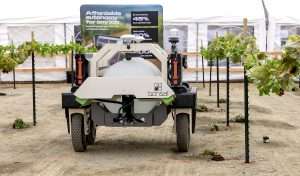
Bonsai Robotics of San Jose, California, makes compact, driverless farm equipment that can carry tanks and sprayers or tow equipment, navigating the orchard by using a combination of camera vision, built-in orchard models and GPS.
The few growers who checked out the demonstrations at a Sunnyside apple orchard said they like the affordability and potential for multiple applications.
Bonsai showcased its Amiga series of vehicles — at their core, a chassis on wheels with cameras and a computer. “A frame and a brain,” CEO Tyler Niday called it.
The company representatives used the Amiga Max, an electric-diesel hybrid, to carry a 200-gallon tank and Interlink tower sprayer for a demonstration using water. Other models rely solely on rechargeable battery packs. The Max itself retails for $59,000; the extra equipment brings it to $105,000.
However, growers must also sign up for service subscriptions of $5,000 to $12,000 per year for maintenance, autonomy service and data access through the Bonsai app, depending on the model.
Other autonomous sprayers surpass $300,000 or $400,000 and can only spray, said Greg Pickel of G.S. Long Co. He could see the Max applying fungicides and herbicides, mowing or moving bins. The company literature says the Max tows up to 5,000 pounds, but Niday said he expects it could handle up to double that.
Bonsai collaborates with other equipment companies to package its platforms with sprayers or weeding heads. The Amiga Flex WEED-IT is a platform embedded with the WEED-IT see-and-spray sensors and nozzles.
“It’s a smart way to do it,” Pickel said.
He plans to advise the growers he works with to at least consider the Amiga line when replacing tractors.
Keith Veselka of farm management company NWFM likes the way Bonsai has attempted to overcome unreliable connectivity by using internal maps and its vision system to fill in when the internet connection fails, as it sometimes does in remote orchards. Even trellis wires have been known to cause interference.
“These guys maybe have found a work-around,” Veselka said. “If it’s true, that’s pretty awesome.”
He also liked the small size profiles, which makes the equipment easier to haul. The Max, the largest of the Amiga line, has some configurations of 4 feet by 4 feet.
Bonsai has about 400 of its robots deployed globally, many of them in almond orchards, Niday said. It also partners with Orchard Machinery Corp. and Flory Industries to factory-fit equipment that would otherwise need a driver.
This week’s demonstrations were the first for Bonsai in the Northwest, and they came to learn as much as sell, said Arlen Frew, chief revenue officer. With a few growers at the demonstration, company representativess discussed how bins are picked up and moved around.
Blueline Manufacturing of Yakima is the Northwest distributor. •
