
In an unrelenting effort to attract customers, Hudson Valley farms constantly look for ways to add value to their fruit, including on-farm sales, craft beverages and meticulous management of premium varieties.
The International Fruit Tree Association saw the diversity, innovation and pressures firsthand when its summer tour traveled through New York’s southernmost fruit region in July.
“I hope if you take nothing else away from this tour, you take away diversity, because we have so many diverse production systems, growers and crops,” Anna Wallis, Cornell University fruit IPM coordinator, told the IFTA visitors.
The Hudson Valley, carved by the Hudson River, runs north to south through Eastern New York, anchored by Albany to the north and New York City to the south. Access to the region’s large markets, especially New York City, has advantages, but it also comes with creeping population pressure, rising land prices and labor competition from other industries.
The valley harvests fruit weeks ahead of New York’s other fruit regions. Its rolling hills provide good air drainage, but its southern location and humidity lead to earlier and more intense pathogen and pest challenges, said Cornell associate professor Greg Peck.

Cornell Cooperative Extension regional tree fruit specialist Dan Donahue said the valley produces roughly 10 million bushels of apples annually, about one-third of New York’s annual production. But the economic impact of those apples is much larger. There are some wholesale growers still in the valley, but most orchards rely on fresh fruit and direct sales to boost bottom lines. No processing industry exists, except for hard cider and other craft beverages, he said.
Jared Buono, director of Cornell University’s Hudson Valley Research Laboratory, said many of the valley’s farms are family-owned yet vertically integrated, which means they themselves handle everything from growing, packing and storing to negotiating contracts and delivery.
Farmers markets, including New York City’s Greenmarkets, represent a lucrative sales outlet for many of the region’s produce growers. Up to 100,000 people walk through the Union Square Greenmarket on busy Saturdays, grower Ken Migliorelli told IFTA. At one point, Migliorelli was selling fruits and vegetables at more than 50 farmers markets each week, he said.
The IFTA tour visited several fruit farms and saw the different methods growers use to add value to their crops.
At Klein’s Kill Fruit Farms in Germantown, grower Russ Bartolotta is known as “The Peach Guy.” He’s probably the biggest peach grower in the valley, with about 70 acres.
“Seventy acres in the Hudson Valley is like 2,000 acres in the San Joaquin Valley,” he said, referring to California’s powerhouse for stone fruit production.
Peaches are a risky crop in the valley, requiring careful management. A late-April 2026 freeze killed many of the region’s apple and peach blooms, but with help from frost fans, helicopters and a little luck, most of his crop survived. He was making at least $45 per half-bushel box of peaches this year, he said.
“Some people think I’m crazy for growing that many peaches,” Bartolotta said. “Well, let them think I’m crazy, because there’s no apple that’s going to generate the kind of money that these things generate.”
Samascott Orchards in Kinderhook relies on size and diversity. The family grows hundreds of fruit and vegetable crops on 1,000 acres. The U-pick portion is 200 acres. To lengthen their season and diversify their offerings, they grow more than 100 apple varieties. They also raise cows and chickens, said grower Jake Samascott.
The Samascotts sell produce at seven New York City markets five days per week, as well as markets in Albany and Massachusetts. They use excess fruit to make applesauce, apple cake, apple pie and other value-added goods, he said.

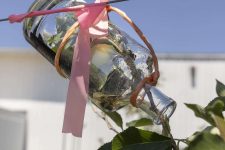
Golden Harvest Farms in Valatie turns its apples into spirits. Cidermaker Derek Grout said his family built a distillery to add value to their surplus apples. They make hard cider, apple vodka, applejack and apple, cherry, pear and peach brandies. To make their apple brandy even more enticing, it’s sold in bottles initially placed over fruiting branches in the orchard, where they let the apples grow inside the bottles until harvest.
Constantly seeking new ways to expand apple sales and turn the fruit into shelf-stable products, Grout started making apple cider vinegar and what he calls balsamic apple vinegar. It took a lot of trial and error to get there.
“We had all these questions nobody had answers to, because nobody’s making balsamic vinegar in America — and certainly nobody I knew of was making balsamic vinegar from apples,” Grout told the IFTA audience.
To meet buyer expectations, orchard manager Rusty Lamb of Yonder Fruit Farms in Valatie does everything he can to maximize the red color of MAIA-1 (marketed as EverCrisp), a late-harvesting variety that’s growing in popularity. Unfortunately, that effort includes aggressive summer pruning in early September, during Gala harvest, he told the IFTA visitors.
Donahue, the Cornell tree fruit specialist, said reflective fabric and spot-picking for color can help growers redden their MAIA-1 apples, but they shouldn’t wait too long to harvest. The apples don’t redden much after mid-October, but they do develop watercore and present a greater risk of storage disorders at that point.
Rose Hill Farm in Red Hook sells fruit primarily through its U-pick and farm stand. Surplus fruit is fermented into wine and cider, said orchard manager Kevin Clark. They also sell fruit to local restaurants, cafes and bakeries.
Rose Hill Farm in New York’s Hudson Valley relies on U-pick customers, who generally need a lot of guidance. (Matt Milkovich/Good Fruit Grower)
Traditional hard cider apple varieties on dwarfing rootstocks at Rose Hill Farm. (Matt Milkovich/Good Fruit Grower)
Hudson Valley grower Ken Migliorelli talks about his family’s farming history and farmers market sales at Rose Hill Farm. (Matt Milkovich/Good Fruit Grower)
“They love the variety,” Clark said. “One restaurant last year didn’t care what it was, they just wanted 10 pounds every week.”
Hurds Family Farm in Modena is known for its U-pick, agritourism and on-farm food, but IFTA got a look at something unusual: a circular apple block designed for center-pivot irrigation. A 429-foot Valley center pivot waters the 3.5-acre block, spaced 5 feet by 5 feet. Grower Charles Hurd carefully monitors the block’s water and nutrition needs before making applications, he said.
Crist Bros. Orchards in Walden is one of the few large-scale wholesale apple growers remaining in the Hudson Valley, producing about 500,000 bushels annually on more than 600 acres plus packing and storing year-round. Grower Joel Crist said they farm on nine different sites in the valley, including the southernmost wholesale apple site in New York. They take advantage of the region’s long harvest window, starting with Gala in early August and ending with Cripps Pink (marketed as Pink Lady) in November, he said.
Cripps Pink apples from 2025 move through the Crist Bros. Orchards packing house in July, during an IFTA tour of New York’s Hudson Valley. Cripps Pink, marketed as Pink Lady, is a profitable late-season variety for the orchard. (Matt Milkovich/Good Fruit Grower)
Grower Joel Crist talks about his family’s vertically integrated apple business. (Matt Milkovich/Good Fruit Grower)
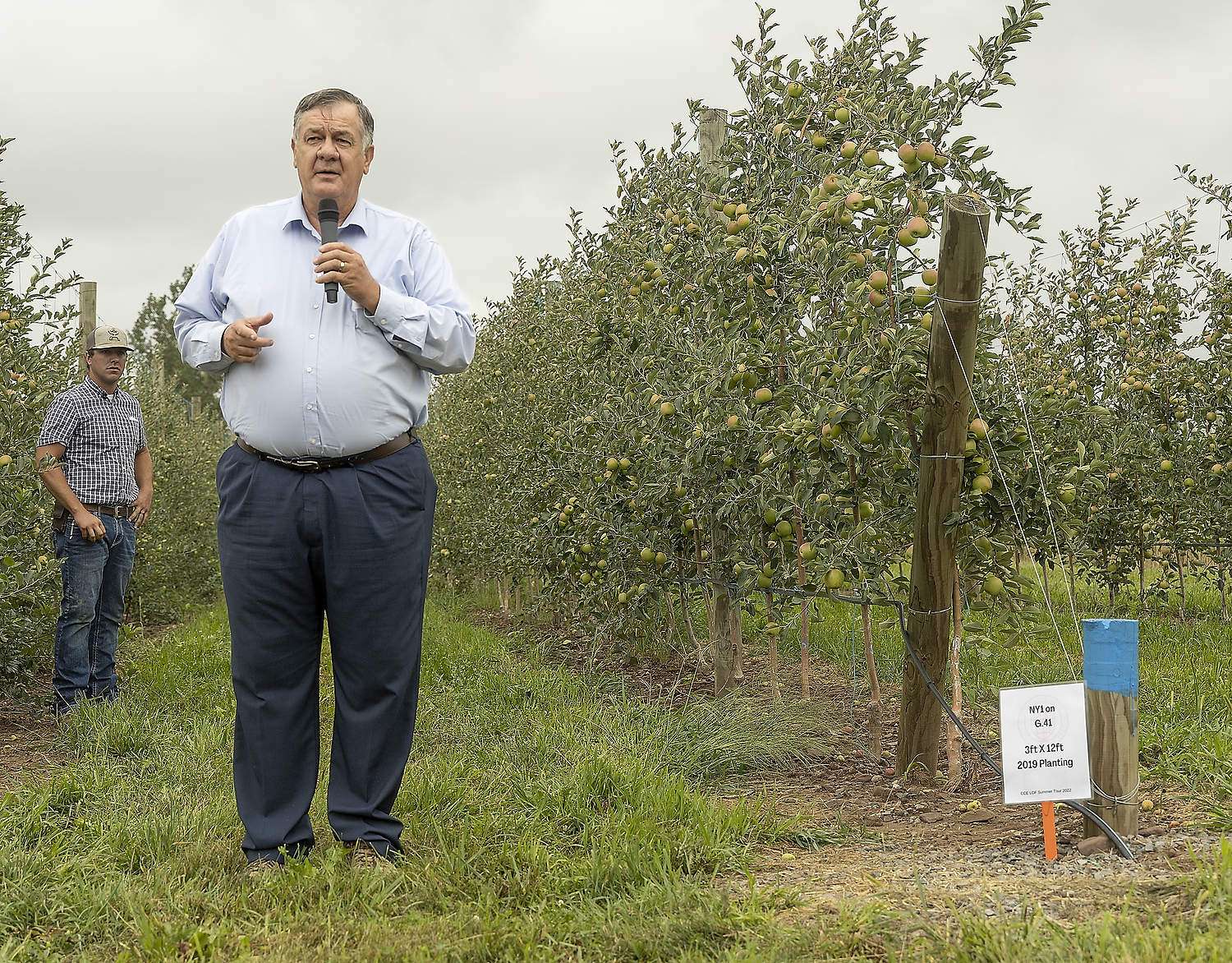
To meet customer demands, the Crists focus on meticulous management and profitable varieties, including Honeycrisp, Fuji and NY1 (SnapDragon). A lot of stem clipping is required. Cripps Pink is an important late-season variety, which they pack and ship year-round. Unfortunately, the April freeze killed most of their Cripps Pink crop this year, Crist said.
IFTA’s final tour stop was the Angry Orchard Cider House, also in Walden, which houses a small-scale cidery and kitchen as a showpiece for America’s largest hard cider producer. The facility includes apple orchards and Cornell research blocks, said Peck, whose lab conducts research projects there.
Peck’s lab has paired traditional European and colonial hard-cider varieties with modern rootstocks and orchard architecture, to see how well the old apples fit with modern growing systems. He has also studied mechanical harvest of cider apples, which is common in Europe but not the United States. •

Related: