
By Julie Tarara, Washington State Wine Commission
As summer heat hits the Northwest, grapevine physiologist Markus Keller and agricultural engineer Lav Khot of Washington State University teamed up to share insights on how and when wine grape growers should try mitigating the effects of extreme heat. They spoke at a Washington Advancements in Viticulture and Enology, or WAVE, webinar about their work, which was supported by the Washington State Wine Commission and the Northwest Center for Small Fruits Research.
Heat basics
Under high temperatures, grapevines experience water stress, which decreases transpiration and evaporative cooling from the vine canopy. Consequently, canopy temperature rises, creating a feedback loop. More water stress further decreases transpiration, which results in even higher canopy temperature. Fruit development also suffers under extreme temperatures.
Shade cloth offers one way to block heat; however, this approach decreases light, increases humidity, and is very expensive. Rather than block incoming solar radiation, Keller, Khot and their teams investigated two ways of removing heat: using misters or applying extra irrigation either before or during heat waves.
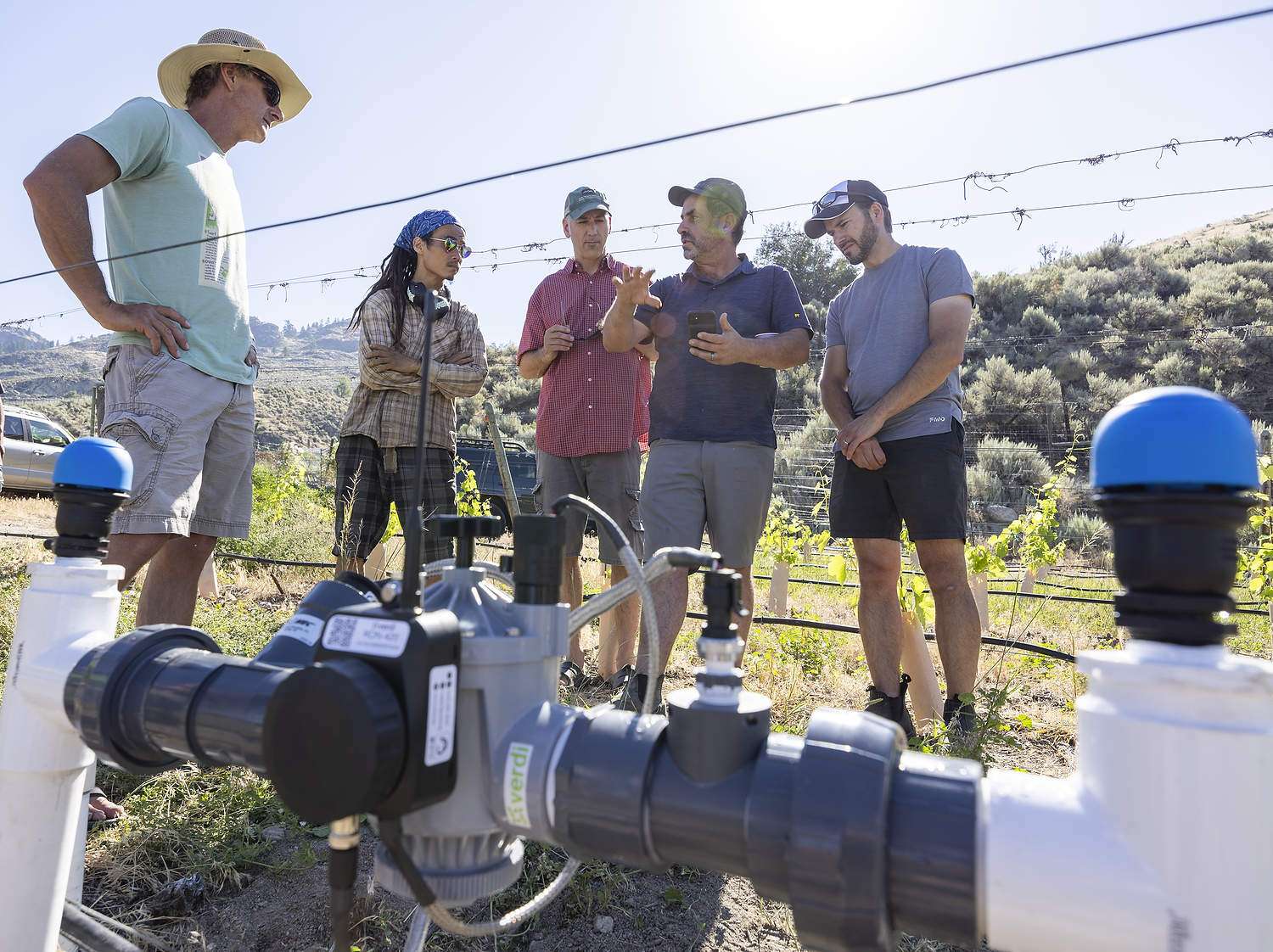
Extra irrigation during heat waves
Work conducted in Keller’s lab, by postdoctoral researcher Charles Obiero, focused on heat waves before veraison, which is the onset of ripening. Small shots of extra irrigation applied daily during heat waves caused extra shoot growth. The extra irrigation also increased the size of the berries, leading to higher yield.
Large berries and higher yields can pose more of a concern in red grape varieties than in white varieties. Small berries have a higher ratio of skin to grape pulp. The berry skin contains many of the desirable compounds for making red wines, such as anthocyanins and tannins.
Obiero found that fruit chemistry at harvest, also referred to as berry composition, was not affected by the extra irrigation — with the exception of flavonols. These compounds, which act as natural sunscreen for the berries, decreased compared to the control. Obiero’s conclusion was that in the period between fruit set and veraison, extra irrigation during a heat wave works to protect fruit yield and quality, but with a trade-off of prompting extra shoot growth. Denser canopies can increase the risk of diseases such as powdery mildew and botrytis.
Concerns remain that extra irrigation, if delivered later in the season, might also cause berries to split.


Under-vine misting targets fruit
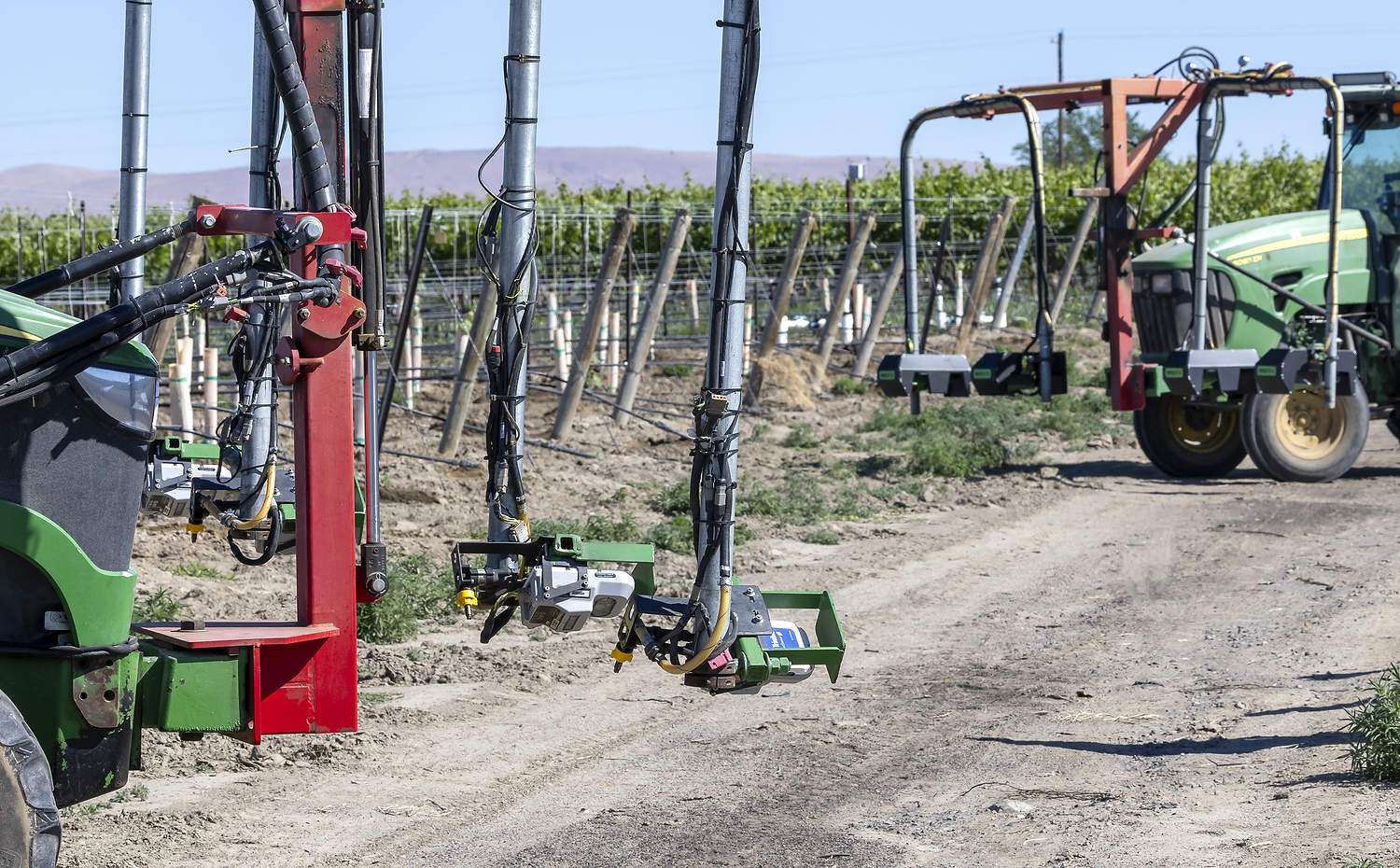
An alternate technique is to apply just enough water to create a cooler microclimate with over-vine misters. Keller’s and Khot’s teams took that a step further by designing a novel automated system with misting nozzles attached to a second drip irrigation tube. The goal was to control temperature in the fruit zone rather than the whole canopy, and to do so without adding extra water to the soil.
According to Keller, leaves are very sensitive to water stress and far less sensitive to high temperatures. By contrast, the chemistry of grape berries is highly driven by temperature. The fruit is fairly tolerant of water stress.
Because of this, intermittent under-vine misting (also commonly known as fogging) is an ideal approach to mitigate heat impacts on the fruit while applying hardly any extra irrigation. The fogging nozzles, rated at 1 gallon per hour, provide just enough water to create evaporative cooling in the fruit zone and drive down the temperature.
Keller’s team measured the temperature of the vines by pointing an infrared thermometer at the vine canopy. Infrared thermometers work by detecting the thermal radiation that is emitted by the target surface, in this case, the canopy. When canopy temperature reached 95 degrees Fahrenheit, Khot programmed the foggers to automatically turn on. When canopy temperature dropped to 86 degrees, the system shut off.
Keller also installed leaf wetness sensors to detect how much water was sitting on the leaf. This provided a backup shutoff threshold to minimize any disease risk. The system typically ran in cycles of 10 to 20 seconds on and 2 to 5 minutes off.
The under-vine fogging system successfully reduced canopy temperature by as much as 20 degrees.
Khot followed up the canopy measurements by directing an infrared thermometer at the fruit. With under-vine fogging, the surface temperature of the fruit dropped by as much as 12 degrees below that of the interior of the cluster.

Doable with deficit irrigation
Regulated deficit irrigation is a standard practice for red wine grapes in Washington state. By controlling irrigation, growers can control shoot growth so that canopies are not too dense and the fruit is not excessively shaded. The under-vine fogging approach applied less than 1 millimeter of water (0.04 inches) per day. This compares favorably with a standard irrigation event that might apply up to 20 mm over a 24-hour irrigation set.
When growers consider cooling strategies during heat waves, they should decide if their aim is to reduce grapevine stress or protect fruit quality. These results show that while supplemental irrigation delivers on the former, fogging focuses on the latter.
“Supplemental drip irrigation during heat waves is great to preserve vine function and yield, but unlike under-vine fogging, it rarely improves fruit composition,” Keller said. •
Julie Tarara is research program manager for the Washington State Wine Commission. She can be reached at: jtarara@washingtonwine.org.