






Don’t take home everything you learn in California.
That was the advice from Kevin Day, longtime University of California Cooperative Extension educator, who shared trends and takeaways from the stone fruit industry with members of the International Fruit Tree Association who gathered in Fresno, California, for its annual meeting Feb. 8–11.
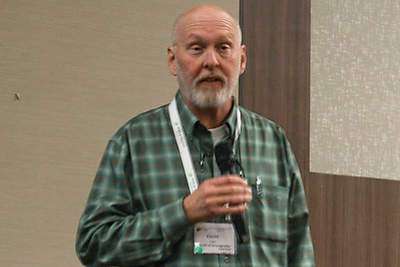
“We don’t just want a cookbook; we know this is a very sophisticated overall system,” he said of stone fruit systems.
California’s direct-light environment interacts very differently with the tree canopy than the diffused light of more humid, cloudy climates does in the Eastern U.S. or Europe. That’s why California growers struggle when they try to emulate European systems, and East Coast growers might struggle with what is working in California’s Central Valley.
“Trying to keep trees 7 to 9 feet tall, reducing reliance, or completely eliminating ladders might make tremendous sense for California,” he said, citing years of his own research. “It wouldn’t make sense at all for a lot of other places where you have frost events two and three and four and five years, you know, and so that is why I suggest that you don’t (fall for) the Hollywood glitz.”
Following his talk, Day was recognized with the IFTA Educator of the Year Award.
Despite Day’s words of caution, learning from other growers in other regions is the theme of the conference, which includes talks on technology use from growers across the U.S., the planar systems experience in New Zealand, the latest in horticultural research, and the economics of a retail-focused farm in New Jersey.
Earnscy Weaver, a grower and consultant in the Otago region of New Zealand, shared his experience with UFO-style cherries, inspired by an IFTA tour of Washington about 20 years ago. After an initial investment in the system and the training, the pruning and harvesting is efficient, he said, and the fruit quality is high.
“Everything is about light,” he said.
Reuwai Hanewald, who recently took over the operations of her parents’ 250-acre farm, Terhune Orchards, in Princeton, New Jersey, shared highlights from some of her 60 crops and how they all fit together.
Her 2.5 acres of cherries draw a crowd of eager pick-your-own customers who will start waiting in line before she opens for the day, even with a relatively high price for the fruit. But the input costs of cherry production are so high that the margin is not as good as her asparagus or pick-your-own bouquet flower fields.

She also shared her strategy for tourist management.
“I always say my farm is for pickers, not tourists,” she said. “You are not allowed in my orchard without a bag.”
Pick-your-own fruit sells for the same prices as in her retail store, but through a pre-paid bag.
“I can’t make people come to my farm, so I am really focused on, if they come, does that visitor have a high-quality experience and high-quality produce,” she said.
She thanked IFTA for the invitation to speak and for being a welcoming community for growers of all sizes to learn from each other.
On Day 2 of the IFTA conference, attendees will head to the World Ag Expo, running nearby in Tulare, California, Feb. 10–12. •