





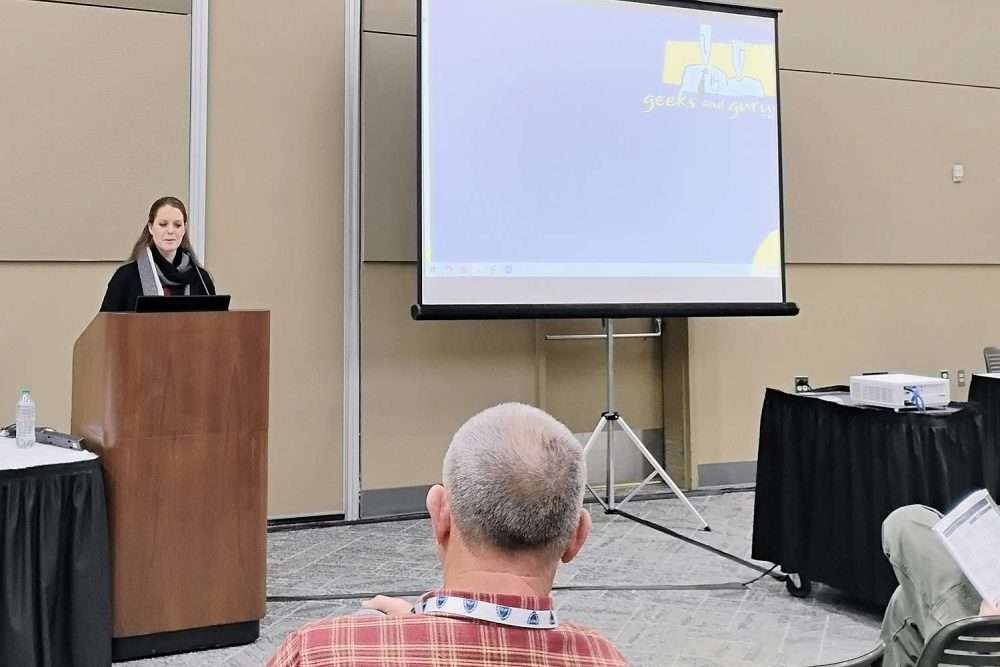
Peaches were one of the topics covered Dec. 10 during Day 2 of the Great Lakes Fruit, Vegetable and Farm Market EXPO in Grand Rapids, Michigan.
During the Peach/Plum 2 educational session, Michigan State University tree fruit educator Emily Lavely discussed peach variety and rootstock trials she inherited from retired MSU tree fruit specialist Bill Shane. Lavely has been conducting the peach trials at MSU’s West Central Michigan Research and Extension Center in Hart. The goal is to find high-quality fresh and processing varieties that are good fits for the Michigan peach industry, she said.
The trials include five fresh freestone selections from the MSU breeding program, and three clingstone processing selections from an Ontario breeding program. The fresh varieties are being grown on Bailey (the standard), an experimental rootstock (semidwarf) and MP-29 (dwarf) rootstocks. They aren’t testing every variety on the experimental rootstock, she said.
The trees were planted in 2022 and started yielding significant amounts of fruit in 2025. The blocks have trickle irrigation and were pruned to a standard V shape. Lavely shared data from the trials so far.
For the fresh varieties, Selection 1 harvests about Sept. 4 and has a nice, dark color. On Bailey, it yielded 156 peaches per tree, its average fruit size was 2.7 inches and average tree height was 9 feet 3 inches. On MP-29, Selection 1 yielded 17 peaches per tree, average fruit size was 3 inches, and average tree height was 6 feet, 1 inch.
MSU Selection 2 harvests about Aug. 29. It has firm flesh and good flavor. It averaged 173 peaches per tree on Bailey, and its average fruit size was 71 to 74 millimeters. Average tree height on Bailey was 8 feet, 7 inches.
Selection 3 harvests Aug. 18 or 19. It yielded 125 peaches per tree on Bailey, and its average tree height was 7 feet, 6 inches. Trees on the experimental rootstock yielded 95 peaches per tree and had an average tree height of 6 feet. Trees on MP-29 yielded 15 peaches per tree and had an average tree height of 5 feet, 4 inches.
Selection 4 harvests Aug. 11. On Bailey, it yielded 70 peaches per tree, and its average tree height was 8 feet, 1 inch. On the experimental rootstock, it yielded 28 peaches per tree and had an average tree height of 6 feet, 2 inches. On MP-29, it yielded nine peaches per tree and its average tree height was 5 feet, 2 inches. Fruit size at harvest averaged 61 to 70 millimeters.
Selection 5 harvests Aug. 29, yielding large fruit with vibrant color. On Bailey, it yielded 96 peaches per tree; on MP-29 it yielded eight peaches per tree. Average fruit size was 73 to 75 millimeters. (Researchers are discovering that MP-29 probably isn’t a suitable rootstock for Michigan conditions, Lavely said).
The processing peaches were all grown on Bailey. Ontario 1 harvests about Aug. 15. It yielded an average of 153 peaches per tree. Average fruit size was 69 millimeters and average tree height was 8 feet, 10 inches.
Ontario 2 harvests Sept. 4. It yielded 185 peaches per tree, with an average fruit size of 72 millimeters and average tree height of 8 feet.
Ontario 3 harvests Sept. 15, similar to Venture, a common processing variety in West-central Michigan. It yielded an average of 124 peaches per tree, with a 75-millimeter fruit size and average tree height of 9 feet, 8 inches. The tree has an upright growth habit, produces very firm fruit and performs well in storage.
Split pit hasn’t been a problem in any of the varieties, so far. They will study disease resistance more closely in the next stages of the trials, Lavely said.
MSU Extension farm business management educator Chris Bardenhagen discussed Michigan Peach Cost of Production 2024, which he co-authored with MSU researchers Lavely, Shane, Derek Plotkowski and Molly Sears. The study, published in October 2025, takes an in-depth look at the cost of producing fresh and processing peaches in Michigan.
Bardenhagen said most Michigan peaches are grown on freestanding, open-center trees. A few growers have tried high-density plantings, but it’s not a widespread practice.
According to the study, there are about 2,250 bearing acres of peaches in Michigan, a quarter of them processing varieties. As of 2024, estimated establishment costs were $9,167 per acre for processing peach orchards and $10,107 for fresh. Ongoing costs of production — including operating, harvest, land control and an allocation for establishment costs — total $5,355 per acre for processing and $7,587 for fresh.
Operating costs are similar for both categories, with the exception of harvest, which is substantially more expensive for fresh growers. About 75 percent of total production costs are variable, making peach production susceptible to input and labor cost shocks, according to the study. •
