




There was much talk of Honeycrisp during RidgeFest, the annual field day held by the Michigan Pomesters. The 2025 event was held July 17 in orchards near Kent City.
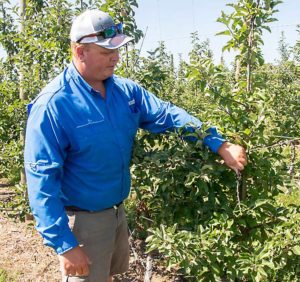
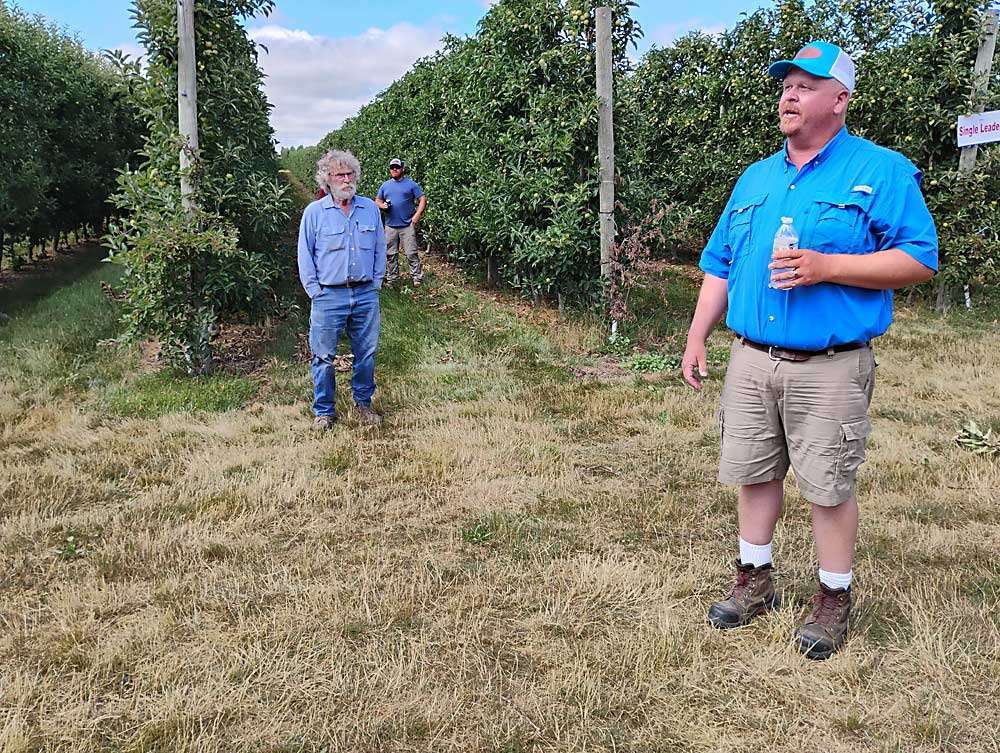
At one of the stops, New Leaf Orchards, grower Bill Nyblad shared some of his strategies for vigor control of Honeycrisp trees. Nyblad is known for experimenting with different horticultural techniques, such as breaking branches to control vigor in Fujis.
In a conversation before RidgeFest, Nyblad told Good Fruit Grower he doesn’t irrigate anything on his 500-acre orchard, including his high-density blocks. One reason: “I like to fish in the summertime,” he said with a laugh. Another is that he worries about bicarbonates in the irrigation water “tying up nutrients and slowing root establishment.”
“Once the trees establish a root system, they’re more apt to catch rainwater,” he told Good Fruit Grower.
Nyblad uses timely trimming, hedging and other horticultural techniques to keep his young trees growing despite drought stress. And fruit size has been fine, even during recent dry summers.
“My apples are just as good as anybody irrigating,” he said. “It hasn’t bitten me yet.”
During RidgeFest, Nyblad led the audience through a block of Honeycrisp on Geneva 30 rootstock, planted from 2016 through 2018. Controlling vigor in the block — “an old cow farm” with “beautiful, thick topsoil” — has been challenging, he said. The trees grow “really fast and aggressive,” he said, and require a lot of hedging and trimming.
“Every 1-year-old branch wants to become 2-year-old wood next year and develop flower buds,” Nyblad told the audience. When that happens, it “zaps the tree of energy and overcrops your tree.”
Nyblad and his crews spend a lot of time in the block “continually beating back fruiting units,” he said. His goal is keeping 1-year-old wood within 8 to 12 inches of the tree. Anything beyond that is cut off.
The trees had a big bloom in spring 2025, and Nyblad was worried about overcropping, but 24-degree (Fahrenheit) temperatures during pink stage provided natural crop load management.
The Honeycrisp block includes single-, double- and triple-leader trees. When multileader trees weren’t available, he bought single-leaders and laid them horizontally, “somewhat like a UFO,” with the branches growing vertically. He removed a few branches from each tree and left two vertical leaders spaced a foot apart. Training and managing the trees is a lot of work, but the eight rows he planted in that style are his “highest production rows,” he said.
Nyblad said the rootstock he’s using for a single-leader tree has enough horsepower for a double-leader, too. The tree is bigger, but so is its root system. If you go to three or four leaders, however, you need to upgrade the rootstock, he said.
The RidgeFest visitors also had lunch in Nyblad’s new, 11,000-bin, state-of-the-art apple storage facility built in 2023.
“Having my own storage is a huge advantage,” he said. “The Michigan apple industry needs more facilities that can store apples 10 to 12 months a year, as long as retailers need.” •
