





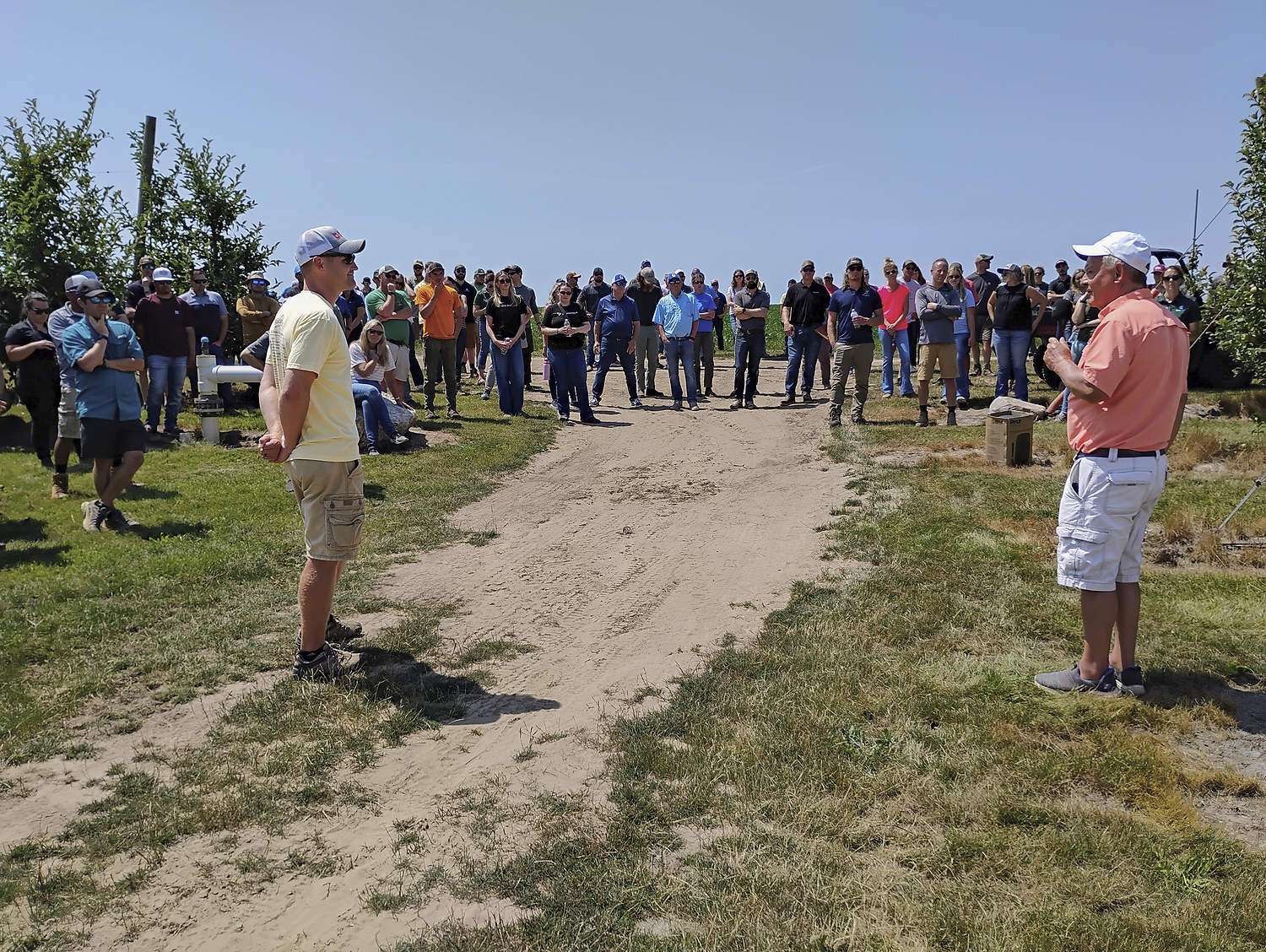
The Michigan Pomesters hit the road for Ridgefest 2026.
Instead of visiting orchards on Michigan’s Fruit Ridge north of Grand Rapids, as the group usually does for its summer tour, they traveled north and west on July 30 to view fruit operations in Oceana County, in the West-central Michigan growing region.
The first stop was Fox Fruit Farms in Shelby, where grower Noah Fox showed the group potted apple trees growing in greenhouses. The Fox family started the technique a few years ago, with the goal of getting young trees into production sooner, he said.
Fox showed the tour 10,000 trees growing in biodegradable pots in two greenhouses, where crews water and fertigate them with overhead sprinklers.
Ideally, the water would be in the soil and not on the trees, but they can fit more trees in the greenhouses using overhead irrigation. Growing potted trees in greenhouses is more expensive than growing them bareroot outside, but the trees grow faster and there’s much less transplant shock, he said.
When the potted trees are ready, crews transplant them in August into fields with trellis and irrigation systems already in place. They start watering the trees right away. Early August is an unusual time to put trees in the ground, but it gives his employees work during a slow time, Fox said.
At Crystal Apple in Mears, owner Scott Swindeman talked about some of the farm’s trellised Honeycrisp and Rave (MN55) blocks. Honeycrisp grows well in the region, he said. Rave is a variety with a lot of potential, but the block on Geneva 41 has had some problems with winter injury and black stem borer, he said.
At Van Agtmael Orchards in Hart, grower Mike Van Agtmael (named the Michigan Pomesters 2026 Fruit Person of the Year) said all new plantings are spaced 11 feet by 2–2.5 feet. Main varieties include Honeycrisp, SweeTango (Minneiska), Gala, Jonagold and EverCrisp (MAIA-1). He likes Budagovsky 9 and 10 rootstocks, but anything on Bud.9 needs irrigation and a good nutrition plan, he said.
The final stop was the Riveridge Land Co. orchard in Walkerville, where farm manager Dan Zemaitis talked sweet cherries and apples. Riveridge, based on the Fruit Ridge in Sparta, planted nearly 100 acres of sweet cherries in Oceana County several years ago, to lengthen its harvest and marketing window.
Growing fresh sweet cherries has been a learning curve, Zemaitis said. They’re still determining the best varieties and rootstocks for Michigan. Most of the trees in Walkerville are spaced 10 feet by 3 feet. Varieties include the Pearl series, Santina, Lapins, Cristalina and Regina. Rootstocks are mostly Gisela 6 and 12, with some Krymsk 5 and 6. Nursery trees are “all over the board” in terms of quality and structure, he said.
The original plan was to train all the cherries to the upright fruiting offshoots (UFO) system, but some trees don’t want to be manipulated that way and start developing dieback problems. So, they’ve gone with other types of multileader systems in some instances, he said.
They use rain covers to keep water off the cherries, which reduces cracking, but cherries need sunlight. They’re still figuring out ideal branch lengths to avoid shading, Zemaitis said. •

