





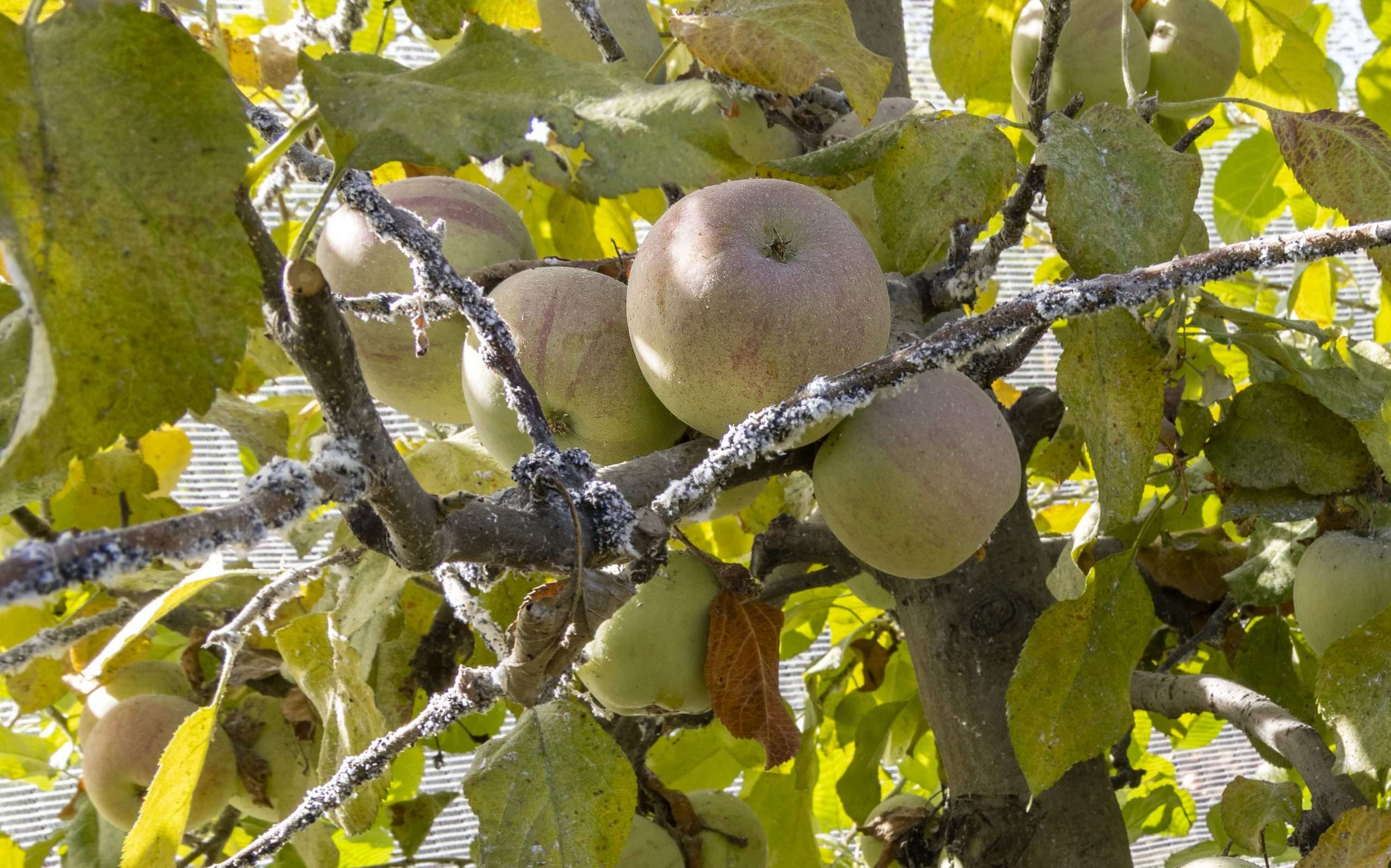
If you want to flare a woolly apple aphid problem in your apple orchard, just cover your trees in netting that prevents movement of both codling moth and beneficial predators.
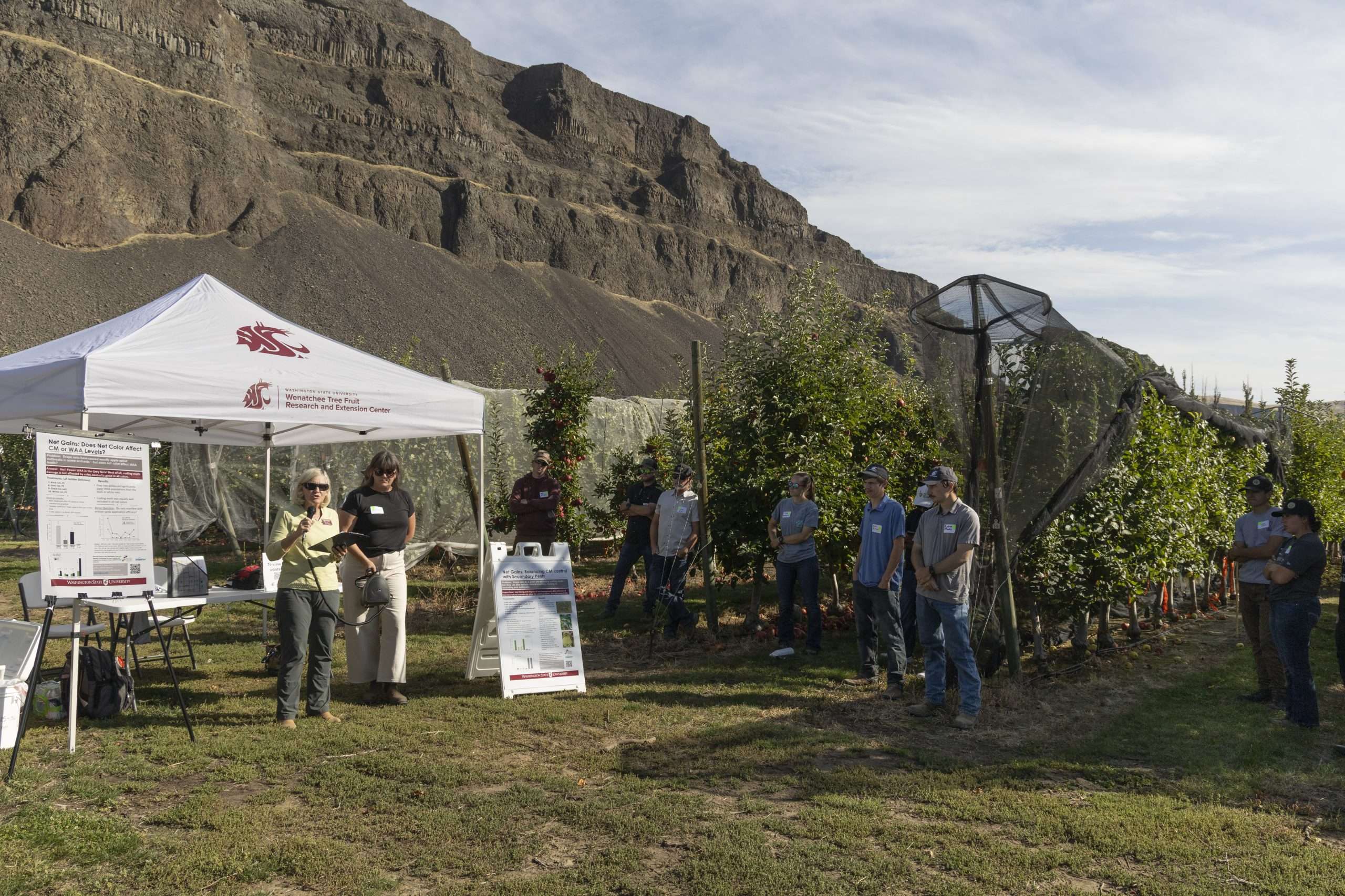
A Fuji block hosting a drape netting trial at Washington State University’s Sunrise Research Orchard underscored just how bad a secondary pest problem can become under nets — if you have one to begin with, said Betsy Beers, a WSU entomologist.
“The goal here is to see if we can address the secondary pest problems without losing control of codling moth, because that’s what you put the nets in for,” she said to attendees during the Sunrise Field Day on Sept. 23.
Last year, she and her colleagues found that using drape netting with the bottom of the net lifted several feet off the ground managed to strike a balance between predator access to keep woolly apple aphids in check and codling moth almost entirely out. But codling moth damage was still a bit higher than she wanted to see.
This year, Beers made two changes to the trials. First, she sprayed the blocks with “a couple shots of Assail” in the first generation, to knock back a rosy apple aphid problem and bring her codling moth population down to the ballpark of a high-pressure commercial block. Then, when she deployed the nets, she rolled them down about a foot lower than last year, to more completely cover the canopy.
“This year, we simultaneously solved the codling moth problem and the woolly problem,” she said.
The trial block is also exploring the optimum timing for dropping nets — second codling moth generation if you have a woolly problem, Beers said — and how beneficial insect release might be used in conjunction with nets, and at what timings.
The trial is funded by the Washington Tree Fruit Research Commission, and the nets were donated by Drape Net USA.
The field day, organized by the WSU Tree Fruit Extension team, consisted of a series of stations where researchers shared updates on pest management, soil health and replant disease mitigation, sun stress and the optimum harvest timing of WA 38.
Rene Mogollon, a WSU research associate, talked about a trial he and postharvest physiologist Carolina Torres conducted on WA 38, the apple marketed as Cosmic Crisp, to understand what factors contribute to the greasiness the apple can sometimes develop in storage. They looked at orchard location, comparing cooler and warmer growing sites, harvest timing based on maturity, and storage regime.
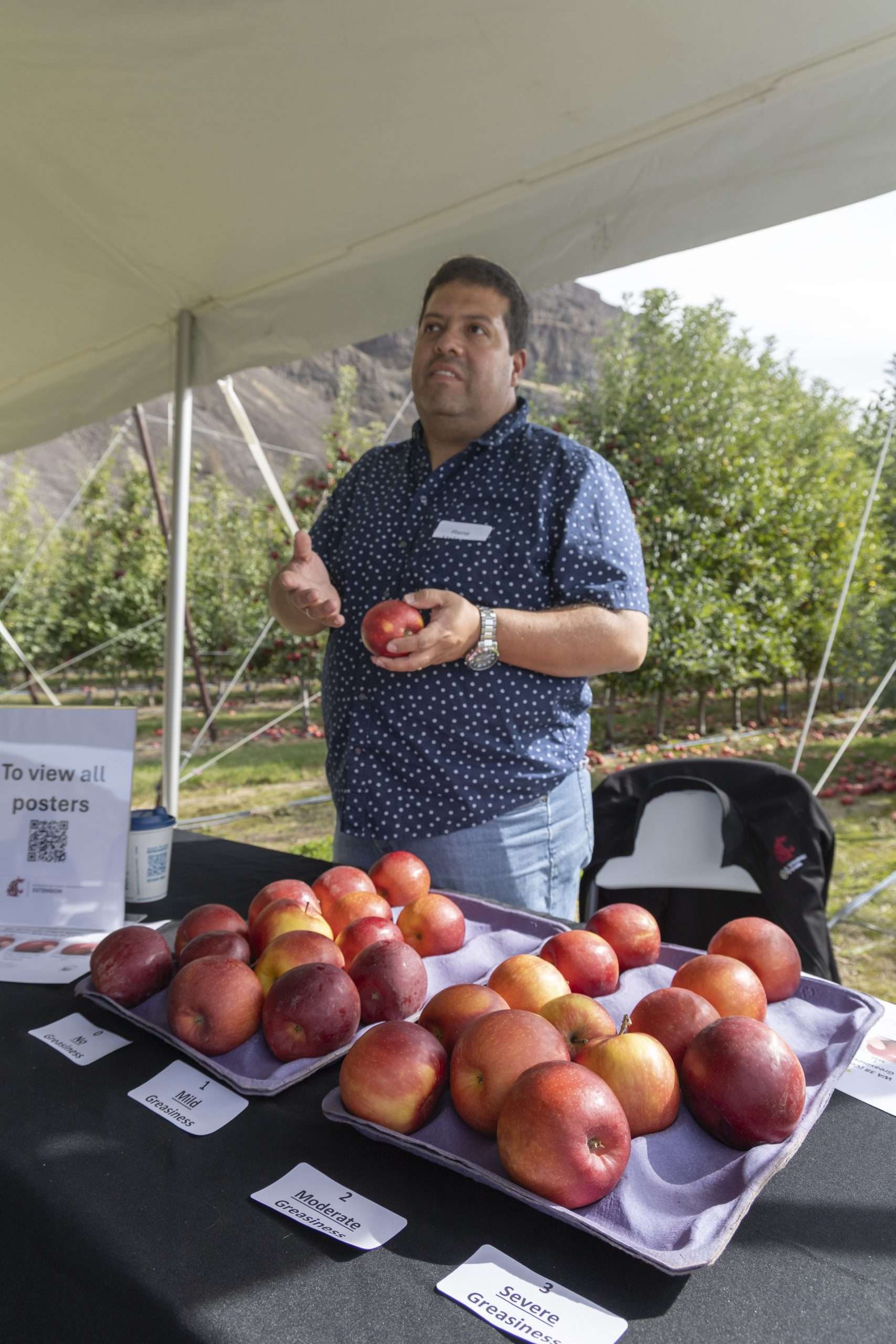
“Later-harvested fruit is more prone to greasiness, with a higher incidence and severity,” Mogollon said.
WSU recommends harvesting WA 38 at 2.5 on the starch scale for the variety. Late, as defined in this study, was 4.0, Mogollon said, which can be just one to two weeks later.
When the weather is warm at harvest and fruit maturity is advancing rapidly, it can be difficult for growers to get all their blocks picked at optimum maturity. Torres recommended using ReTain (aminoethoxyvinylglycine) or preharvest 1-MCP (1-methylcyclopropene) to help manage harvest timing. Both have been shown to reduce greasiness associated with advanced maturity. •