






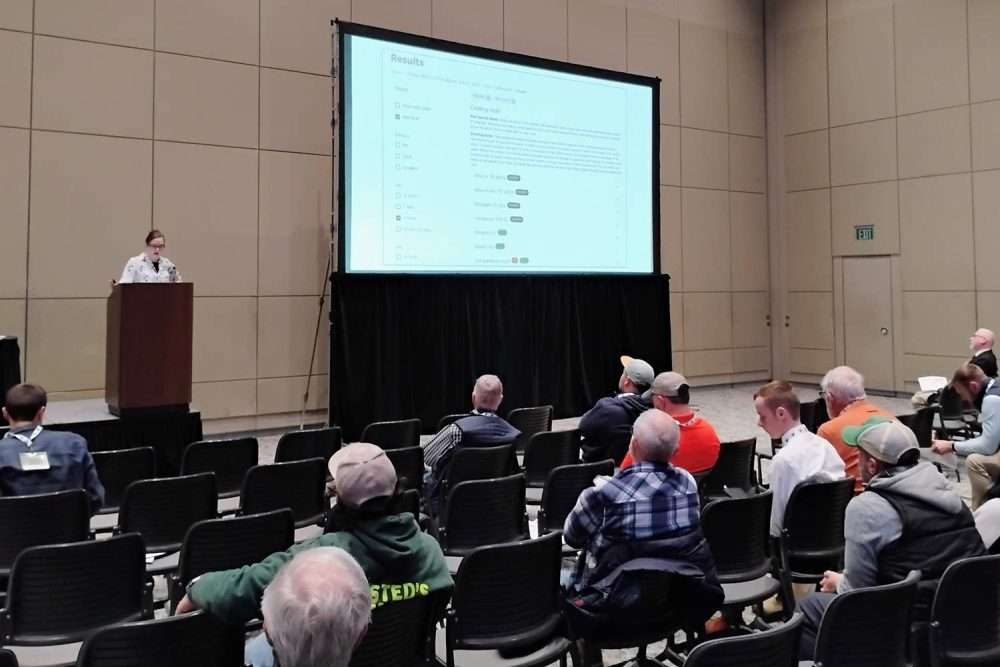
Day 1 of the 2025 Great Lakes Fruit, Vegetable and Farm Market EXPO is in the books. The EXPO’s Apple 1 afternoon educational session included a couple of presentations related to climate change.
Michigan State University tree fruit integrator Jackie Perkins discussed climate change adaptations for pest management in Michigan. Like everywhere else, the state is experiencing shifting climate patterns, Perkins said. There’s less rain overall, and rain events are fewer but more intense. Springs are wetter but summers drier and hotter. There are more growing degree- days per season. Fewer days reach below freezing temperatures in winter.
These climate shifts are affecting insect pest behavior in ways that are still being studied. Some pests are increasing their geographic range, some are surviving winter in greater numbers and some are producing more generations per year.
Perkins said pheromone mating disruption of codling moth can be tricky with warmer temperatures. Longer seasons and more generations of the moth per year mean more chances for control, but the control windows are shorter because the moths develop more rapidly. If your timing is off, especially with the pest’s first generation, the infestation can become more severe.
Insect pest behavioral shifts are ongoing and not fully understood, but Perkins gave some general management advice during the session:
—Select control products based on the life stage of the target pest.
—Use selective pesticides rather than broad-spectrum products whenever possible.
—Rotate pesticide chemistries. More generations of pests per season increase the possibility of the pests developing resistance.
—Prioritize scouting. Get your traps out early.
—Utilize mating disruption when appropriate.
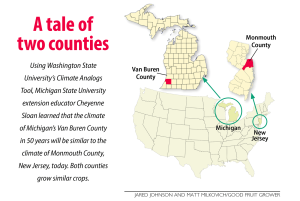
Perkins also listed some online tools growers can use. Washington State University’s Climate Analogs Academy (wsu.edu/resources/climate-analogs-academy/) can help growers find climate analogs — other regions that their current region might resemble climatically in a few decades. She also mentioned the websites climateready.msu.edu and mifruitdecision.com, which can help growers better determine their farms’ vulnerability to climate change risks.
During the same session, MSU horticulture professor Todd Einhorn discussed the vulnerability of apples to shifting winter freeze and spring frost events. The Great Lakes water cordon around Michigan has provided good protection from frosts and freezes for the state’s fruit, but with changing climate patterns that buffer isn’t as consistent as it used to be, he said.
Late-winter temperatures are warmer, which leads to earlier bud development and greater vulnerability to spring frosts. Though spring frost events are happening earlier in general, they still occur randomly and can still lead to fruit loss, he said.
Einhorn and other researchers are studying the shifting weather patterns in hopes of developing new predictive models, critical temperature charts and practical protocols growers can use to mitigate fruit-killing frosts and freezes. He said plant growth regulators containing abscisic acid and ACC (1-aminocyclopropane-1-carboxylic acid) can aid defoliation in fall, which can help enhance cold acclimation and induce dormancy. But, he said, they’re still refining spray timings to avoid defoliating trees too early.
Day 2 of the Great Lakes EXPO will include more fruit educational sessions and industry awards. •
