




It’s not all bad in Washington, D.C.
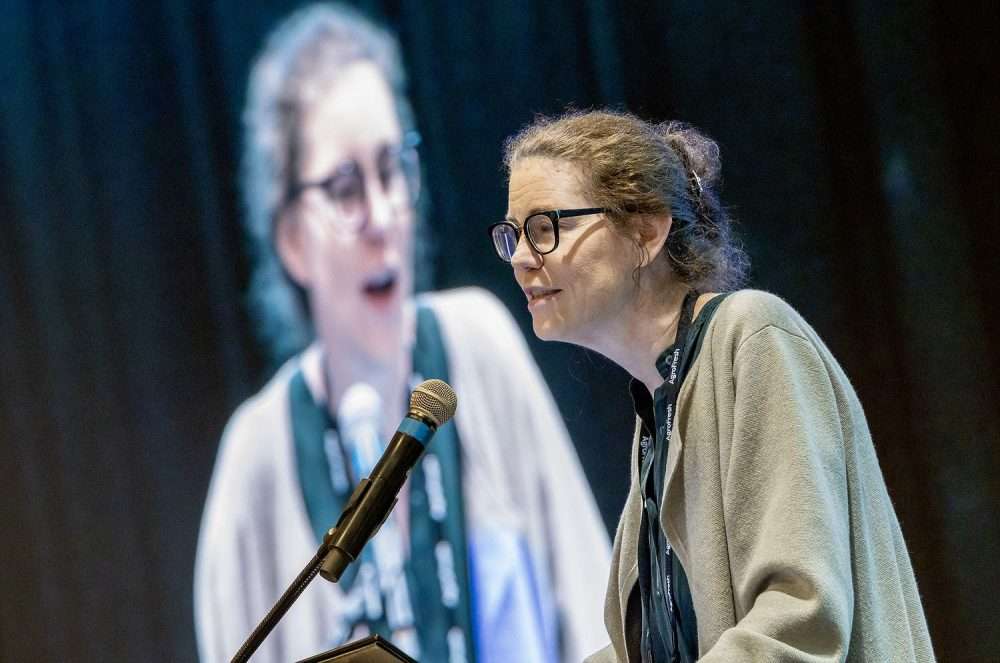
That’s what Washington Post columnist Megan McArdle told growers at the Washington State Tree Fruit Association Annual Meeting on Monday, Dec. 8, at the Wenatchee Convention Center.
“Things are starting to change in Washington (D.C.),” said McArdle, the keynote speaker for the annual meeting of the state’s tree fruit industry. “It’s going to be slow. I think things are starting to change a bit in our culture. That’s going to be slow, too.”
The annual meeting and trade show will continue through Wednesday, Dec. 10 with educational sessions on labor, technology, pears, pests and disease. On Tuesday evening, the industry will celebrate with the annual awards banquet.
An accompanying trade show is held all three days at the nearby Town Toyota Center, with shuttle service to and from the conference center.
McArdle, a self-described libertarian, grew up in New York City but often visited her grandfather who owned a gas station and 2-acre garden at which his nine grandchildren were expected to help pick and can produce every summer. Hers was an upbringing with similar connections to the working class in the nation’s capital a decade ago. Not anymore.
She painted a picture of D.C. today as full of well-meaning but out-of-touch politicians and advocates who believe in making the world a better place but never get beyond theory.
She used immigration as an example. Progressives truly believe the American dream should be available to everyone, but they don’t want to answer the question of where to put millions of people if they all flooded open borders. Conservatives truly believe in law and order, but they don’t stop to think about how construction, farming and other industries would fare without so many of those workers.
However, she is “bullish on America,” she said, because she sees people coming together over the practicalities of life, making concessions about land use, taxes and hiring. She expects D.C. to do the same, because the 342 million Americans represented there will demand it as anger becomes tiring.
She encouraged growers to describe their lives, using social media to paint a realistic picture of struggles — if they use social media at all. One of her favorite videos is of a Seattle restaurant owner who walked viewers through his day and showed the math about how wage mandates affected his business.
“You can talk to more people who are different from you,” she said. “You can show them your lives. You can show them what it is like to do what you do. … That matters for making people understand all the constraints you’re working under, why it’s so hard. It’s good for America, it’s good for us to know more about each other.”
Jon DeVaney, president of the Washington State Tree Fruit Association, also struck a hopeful tone despite recognizing the industry’s challenges.
“We have seen some positive changes,” he said. And more might be coming.
For one, Washington Gov. Bob Ferguson has shown he believes farmers face a lot of challenges. He visited Wenatchee in recent weeks for an industry roundtable and seems willing to work on mitigating the financial strain of the state’s overtime mandate. Also, starting Jan. 1, the state will automatically exempt H-2A employees from WA Cares Act taxes, which fund voter-approved long-term care in the state.
The tree fruit association also may ask the state for financial help with acreage removal.
CarrieAnn Arias of Pear Bureau Northwest told growers that Bartletts weren’t the only variety struggling after the Del Monte cannery closure in Yakima. Many varieties of pears came in at a higher volume than the five-year average. Anjous are up 30 percent, and Boscs are up 56 percent. That means growers of all varieties have challenges, she said.
She also said pear imagery for the brand USAPears, which the pear bureau manages, will start to look less polished. Marketers often make fruit look perfect, but that’s never what shoppers see in stores.
“Sometimes our fruit looks like it’s been in a bar fight,” she said. That doesn’t mean it’s bad and that consumers won’t like it.
Diane Kurrle of the U.S. Apple Association told growers her federal advocacy group is seeking permanent fixes to problems, so that some of 2025’s regulatory wins aren’t stripped away under the next president.
In 2025, the U.S. Department of Labor changed Adverse Effect Wage Rate calculations that effectively lowered the wage floor for H-2A workers. The U.S. Department of Agriculture also increased Marketing Assistance for Specialty Crop payments, from $125,000 to $900,000.
Greg Lang, a professor emeritus of agriculture at Michigan State University, gave the Batjer Address, the educational highlight of the conference. He told growers they need to continue to find new ways to efficiently produce the highest-quality fruit, the way they have been doing for the past 30 years or so.
Dwarfing rootstocks and planar canopies have helped, but he sees new genetics and technology making the difference in the future. For example, growers and researchers are exploring “hortivoltaics,” putting solar panels or nets that catch solar energy over portions of orchards to harvest sunlight for energy, as well as for plant growth.
“Try to optimize the value that you can get from that free sunlight,” Lang said. “That’s the one thing we’ve got as orchardists that’s totally free, and it’s not changing in terms of input costs. So how can we extract more value from that?”
In the afternoon session, West Mathison, CEO of Stemilt Growers, and Welcome Sauer, a retired fruit industry executive, shared a repeat of the talk they gave on apple supply and demand at the U.S. Apple Association’s Apple Outlook meeting in October.
Well, not exactly the same talk.
“I’d say my tone has changed a little bit, to be a little more optimistic,” Mathison said to open his talk.
Why? Well, the expected 142-million-box crop actually came in at 131 million, according to the December storage report. Mathison attributed that to a September hot spell that cut into fruit quality and to strict standards that had growers leave subpar fruit in the field.
“It’s not about what’s on the tree, it’s what we can pack and sell,” he said.
In particular, Gala and Honeycrisp came in below estimates, which will — hopefully — help to drive up prices a bit, he said.
The low prices growers have faced in recent years are a simple matter of supply and demand, Sauer said.
“As we’ve introduced new varieties, Fujis have taken it on the chin,” he said. That’s the natural cycle of the industry, and it would help growers to admit it and remove those out-of-favor varieties.
“Do I mourn the loss of my grandfather’s varieties, the Winesaps and the Jonathan’s? I don’t,” he said. “We are still producing our fathers’ varieties.” •
