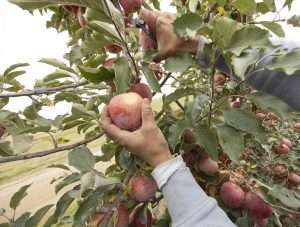







The U.S. Department of Agriculture and U.S. Apple Association estimated a U.S. apple crop of 263 million (42-pound) bushels for the 2026–27 crop year, about a 6 percent decrease from last year.
Chris Gerlach, USApple vice president of insights and analytics, shared the crop estimate in Chicago on Aug. 20 during the industry group’s annual Outlook conference. The estimate comes in the midst of a challenging period for the U.S. apple industry, still squished between low fruit prices and rising input costs.
“Today’s talk is titled ‘Optimism on Uneven Ground,’” Gerlach told the USApple audience. “That is as succinct as I can be, judging by the current state of affairs.”
The last few seasons have been challenging for U.S. apple growers. With domestic demand flat and exports below historical levels, farmgate prices have remained low for most varieties while costs continue to rise, putting pressure on margins and often leading to negative returns, he said.
At the state level, Washington is expected to produce about 176 million bushels for fresh and process markets, a 2 percent decrease from the 2025–26 crop, Gerlach said.
There’s more interest than usual in that Washington number, after the state’s industry decided against releasing its own fresh market estimate earlier this summer. That decision stems from a growing recognition that the market — rather than orchard production — dictates the ultimate volume of apples sold, according to the Washington State Tree Fruit Association, which previously complied the state’s apple forecast.
During the conference’s regional breakout sessions, Washington representatives declined to refine the USDA number.
Meanwhile, New York is projected to produce about 32 million bushels, a 10 percent decrease from last season. Michigan is expected to decrease production by 1 percent, to 25 million bushels, Gerlach said.
At the varietal level, Gala is expected to retain the top spot with almost 42 million bushels, about 16 percent of the U.S. apple market. Red Delicious and Granny Smith will follow with 30 million bushels each. Honeycrisp will come in with 27 million bushels and Fuji with 23 million bushels, he said.
At the global level, top producer China will produce an estimated 1.8 billion bushels in 2026–27, a 1 percent increase compared to 2025–26. Europe will drop considerably from last season, producing about 508 million bushels. South America will produce about 127 million bushels. Mexico will fall to 47 million bushels, down 1 percent from last year. Canada is expected to decrease production by 2 percent, to almost 19 million bushels, Gerlach said. •