




Sanitizers, calcium chloride, pear ester and other materials important to organic tree fruit are open for public comment this month, according to a news release from the Northwest Horticultural Council.
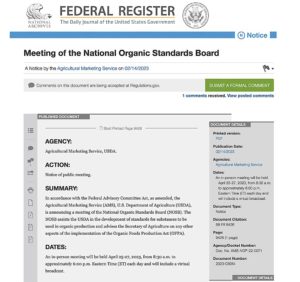
The deadline to submit comments to the U.S. Department of Agriculture’s National Organic Standards Board is May 4.
The Northwest Horticultural Council encourages organic industry members to submit comments on materials under review to voice the challenges faced by organic farmers and stakeholders. Comments can be as simple as a few sentences expressing why these materials are important to Pacific Northwest organic tree fruit production.
The NOSB will begin review of the materials up for sunset review from the National List of Allowed and Prohibited Substances. The materials important to tree fruit growing and packing that are under sunset review this year include:
—Ozone gas: used in irrigation system cleaning.
—Environmental Protection Agency List 3 inerts: inert ingredients used in passive pheromone dispensers only.
—Calcium chloride: a plant nutrient, for use as a foliar spray to treat physiological disorders associated with calcium uptake.
—Magnesium oxide: a crop or soil amendment, for use only to control the viscosity of a clay suspension agent for humates.
—Peracetic acid (PAA): sanitizer and disinfectant, for use in disinfecting equipment and to control fire blight bacteria.
—Chlorine materials: algicides, disinfectants and sanitizers used in irrigation systems and food contact surfaces.
—Calcium hypochlorite: used to disinfect water in cherry hydrocoolers and packing-line wash water, and to sanitize food contact surfaces.
—Chlorine dioxide: used to disinfect and sanitize food contact surfaces and storage rooms, and as a fruit rinse in dump tanks and spray bars.
—Hypochlorous acid: used to sanitize packing-line flumes and to help control fire blight.
—Sodium hypochlorite: used to disinfect and sanitize food contact surfaces and storage rooms, and in dump tanks.
Additionally, the NOSB is scheduled to conduct its final vote on a years-long petition to allow pear ester (Ethyl-2E,4Z-Decadienoate, also known as DA), a semiochemical, to the national list as a synthetic kairomone. Pear ester is a critical ingredient in mating disruption products, such as passive dispensers, traps and lures used as part of codling moth control programs. The listing will include an annotation clarifying that “microencapsulated formulations” of pear ester mating disruption products are prohibited because of the NOSB’s concerns over microplastics. The NOSB’s pear ester discussion document can be read online at: https://www.ams.usda.gov/sites/default/files/media/CS_PearEster_PetitionProposal_508.pdf.
To see the spring meeting agenda, go to: usda.gov/sites/default/files/media/Agenda_NOSB_Spring2026_OmahaNE_External_508.pdf.
For meeting and comment submission information, go to: usda.gov/event/national-organic-standards-board-nosb-meeting-spring-2026.
Written comments can be submitted via: regulations.gov (Docket # AMS-NOP-25-0914), with the deadline on May 4 at 8:59 p.m. Pacific time.
Tips on submitting comments can be found online at: regulations.gov/commenting-guidance.
More information on the NOSB agenda and how to submit comments is on the NHC website at: nwhort.org/organics. If you have any questions or would like assistance submitting comments, contact Dan Langager by email at: langager@nwhort.org or by phone at: 509-453-3193. •