



Dave Bryla gets a common question: Just how much water do blueberry bushes need?
If only the research horticulturist had a single number to give out.
“Easy question, not so easy answer,” said Bryla, a U.S. Department of Agriculture research horticulturist.
So, Bryla and his team at the Corvallis, Oregon, Agricultural Research Service station use intricate scales to build models that will predict blueberry water needs based on weather.
Bryla is starting the fourth year of his project to measure evapotranspiration and calculate irrigation coefficients, ratios of water use compared to a standard crop, usually fescue or alfalfa.
“Obviously, a blueberry field is going to have a different water requirement than a grass field,” Bryla said.
Also, the coefficients will change across plant maturity, time of year, cultivar and spacing.
The coefficients will not, however, change with geography. Growers near his lab in Oregon’s Willamette Valley, with a Mediterranean-style climate on the state’s west side, along with growers in the arid Columbia Basin of Eastern Washington and those contending with the hot and humid summers in Michigan and New Jersey will all be able to use his figures.
“That’s the beauty of a crop coefficient,” said Bryla, also the acting research leader for the Corvallis station.
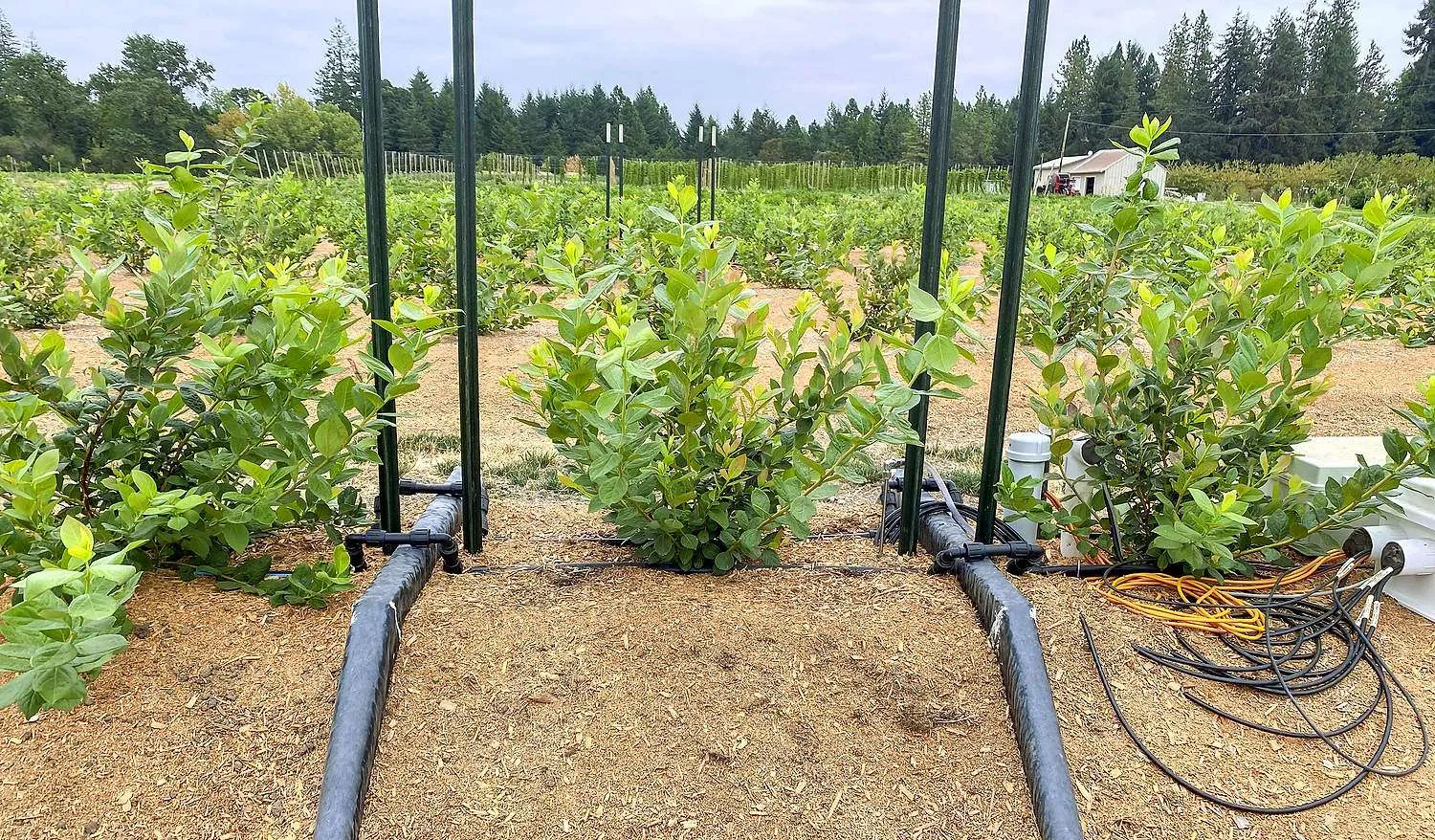
To develop the ratios, Bryla and engineers built an intricate underground scale called a weighing lysimeter, which lies under a blueberry bush and measures the volume of water in the plant and surrounding soil before and after irrigation — the evapotranspiration.
The idea of coefficients is not new. They have been established for apple, peach and many vegetable crops, but not all specialty crops. And some are quite old, based on research decades ago with equipment that would seem rudimentary today.
Bryla has developed many coefficients — including peach — through his work at the ARS in California. He started research with small fruits in Corvallis in 2003, and it took nearly 20 years to rustle up the money and specialized expertise to build and install the sensitive equipment. The type of scales that can track soil weight over time and account for drainage and evaporation aren’t sold on store shelves. The data collection itself is slow and meticulous, too.
When growers and researchers need crop coefficients for plants that have not gone through such an intricate study, they use a theoretical coefficient, one extrapolated from similar crops. For example, grapes sometimes stand in for blueberries, as do apples for pears.
So far, his research tells him that the crop coefficient for a first-year blueberry plant is 0.1 to 0.42, depending on the time of year. Year 2 is 0.43 to 0.77. Year 3 is 0.43 to 1.1.

Bryla plans to keep measuring in Year 4 and to determine how diseases, drought, netting and other factors will skew the ratio. So far, he has tested only near ideal conditions.
That’s why he still advocates for soil moisture sensors. Coefficients are a starting point, he said.
“You still want to be monitoring what happens in the soil,” he said.
He eventually wants to come up with data that will directly correlate his figures to canopy volume as measured by new-generation optical sensors.
In practice
For the past two years, AgriCare has used coefficients to guide irrigation for about 1,200 acres of blueberries throughout Oregon, after consulting with Bryla, said T.J. Hafner, agronomy manager for the Willamette Valley farm management company.
The company has noticed more consistent growth and more efficient use of irrigation, Hafner said. The managers discovered they were overwatering in places, something blueberries are sensitive to, especially organic blocks.
The company also monitors with soil moisture sensors, some checked by hand and others connected remotely to a computer interface, because even crop coefficients aren’t perfect.
“It’s something that needs to be finessed,” he said.
Increasing drought risk and new automation tools that control water based on data make coefficients more important, said Troy Peters, director of the Washington State University Center for Precision and Automated Agricultural Systems in Prosser. Those algorithms need the correct math baked in.
Growers of specialty crops in the arid stretches of Eastern Washington use coefficients. Many use models from AgriMet, a U.S. Bureau of Reclamation website that tracks weather and water use throughout the West.
Blueberries are not alone in the need for more information, Peters said.
“There’s lots of crops we are just guessing on,” Peters said. •